Community guide to working with volunteers
20-03-2026
Get started with...
How community-based organisations can work with local volunteers to create greener, healthier, happier neighbourhoods.
©National Trust Images / Rebecca Hughes
20-03-2026
Get started with...
©National Trust Images / Rebecca Hughes
Volunteers offer extra hands, diverse skills and connectivity, helping to make neighbourhoods greener, healthier places to live.
Research shows that volunteering has mental, physical and social benefits for individuals who give their time too.
As an organisation looking to recruit them however, you’re competing with Netflix, video games, clubs, pubs, sports – anything people choose to do with their spare time.
The good news is there are lots of ways to support people to lend a hand.
Broadly, volunteering can be either:
This guide is to help community organisations cut through the noise of busy lives to mobilise people power in their neighbourhood. Scroll down or click the links to find out more about:
We also have a guide for local authorities who want to mobilise the power of volunteers across their town or city.
©National Trust Images / Rebecca Hughes
Casey Morrison, Community & Participation Specialist at the National Trust.
©National Trust Images / Rebecca Hughes
Casey Morrison, Community & Participation Specialist at the National Trust.
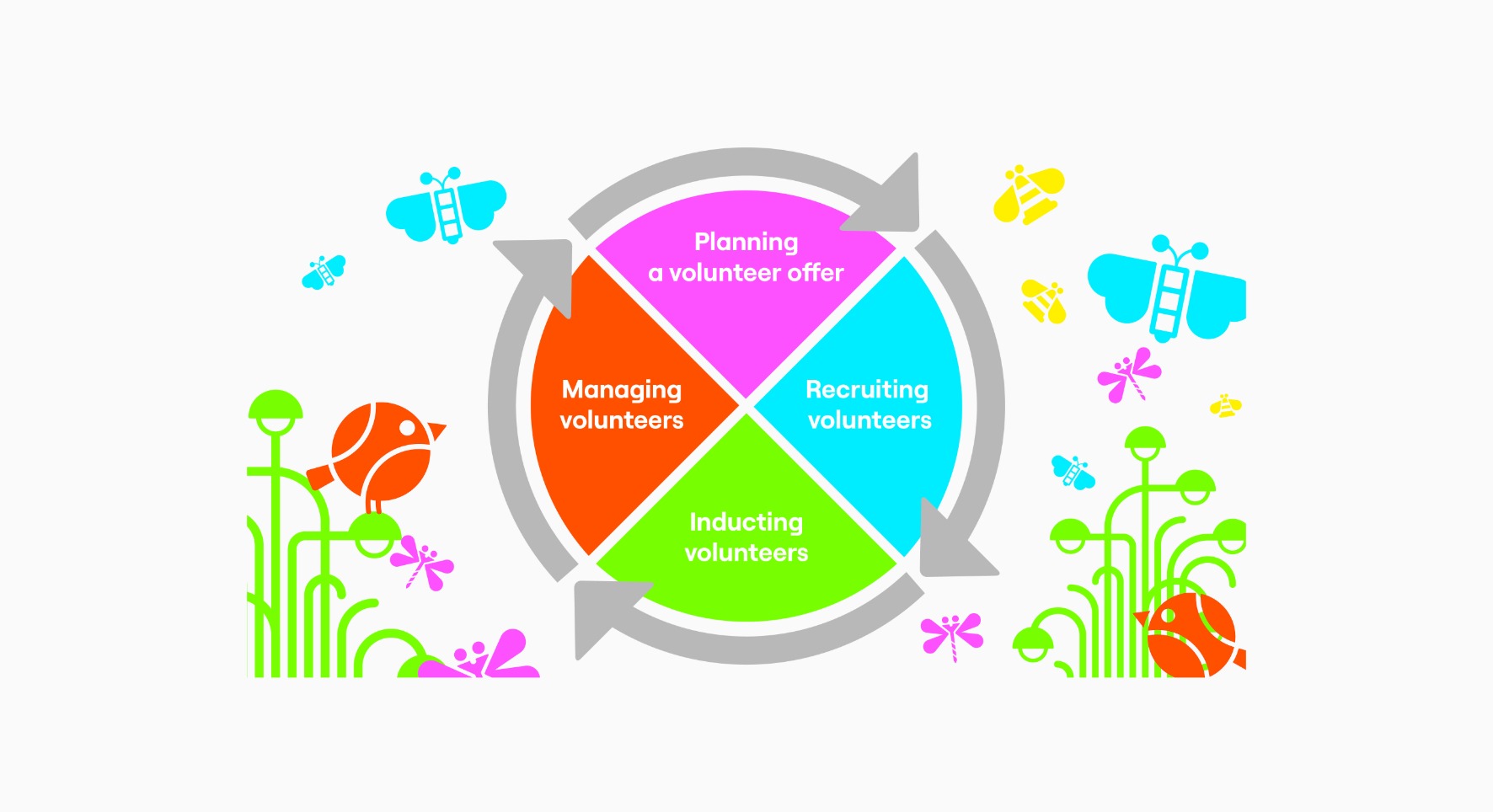
This process helps community organisations bring a diverse range of volunteers on board. It helps volunteers to feel supported and see the impact of their work. It's based on a journey designed by Community Action Suffolk.
Thorough planning builds the foundations for a brilliant volunteering offer that brings value to both volunteers and community organisations, motivating individuals and groups to support for longer.
Involve colleagues who will be managing or working with volunteers in the planning process to gain their insights and buy-in from the offset.
Expand the drop down arrows to get started with planning.
Volunteers are contributing their time and skills for free and are far more likely to stick with it if they are having a positive and fulfilling experience.
A quality volunteering experience is likely to include:
Be clear on the desired outcome of involving new or more volunteers, and the timeline and approach for doing so.
A volunteering strategy will help you to develop a strong volunteer offer and consolidate the planning process. Here are some links to get started with a strategy:
Volunteer profiles outline what a role involves. They are important because they help people decide if a role is suited to their skills and interests, manage their expectations and see the impact that they could make.
Consistency across role descriptions is important, and accessible versions should also be available (for example, large print or video format).
Helpful things to include in a role description are:
Take a look at the NVCO website for more ideas.
Think about how you can create or adapt a role so it’s accessible to people with different backgrounds, skills, experiences and abilities.
It may also be useful to refer to specialist advice on inclusion and accessibility. Here is some guidance to help:
One-off volunteering gives participants an opportunity to dip their toe into volunteering. Here are some things to consider:
Here are some of the essentials you still need to cover for one-off volunteering activities:
Volunteer Now has more ideas for one-off volunteering here.
Once you understand your priorities and have planned your volunteering offer, it is time to recruit new volunteers to your team.
Expand the sections to get prepared.
Make sure you have a recruitment plan and resources in place before you get started. Some things to think about are:
The Volunteero website’s page on volunteer recruitment and Volunteer Playbook provide helpful information on recruitment too.
Volunteers are in high demand. How will you make your role stand out in the crowd?
Consider the following when promoting your volunteering role:
Additional resources on promoting your role here:
How to write the perfect volunteer recruitment advert – Charity Digital
There are lots of places to advertise your volunteering role, and many of them are free of charge. If you want to broaden your reach, think about where best to advertise your roles to reach new audiences.
Suggested ways to advertise volunteering roles from the NCVO website include:
A good application process helps you get to know prospective volunteers and match them to a role that suits their skills and interests. However, weighty application forms and processes can also be a barrier to people applying. Keep your application process for volunteering roles clear, simple and fair.
Some examples:
Having a good selection process in place helps you find out more out prospective volunteers. Be clear on your criteria and keep the process fair.
Consider the following before you get started:
During the selection process:
The need for screening is dependent on the role. When writing your role descriptions, you will need to consider if additional checks are required. You might like to consider:
Inductions are a chance to introduce new volunteers to the organisation and their role.
A supportive process helps them feel confident and creates a sense of belonging from the get-go. As with every stage of the volunteering journey, thorough planning is key to success.
Expand the drop-down arrows to get started.
Start by considering the following:
Different roles and organisations will have different induction requirements. Helpful things to include are:
Useful to consider documentation that can support this:
There are lots of free resources available to support with volunteer inductions. Here is a selection:
All staff leading or working with volunteers should be responsible for supporting an excellent volunteering experience.
Ongoing support for your volunteers is crucial. It will help keep them motivated and happy, ensuring their energy and enthusiasm is harnessed to benefit your organisation and cause.
Clearly define how and when you can support your volunteers and make it clear who to contact if they need more help.
Expand the drop-down arrows for tips and ideas.
Some general ways to support your volunteers are listed below.
It’s crucial to make sure you get to know the individual needs of the people you’re supervising. That way, you can provide additional support they might need beyond this list, and spot changes or personal issues that may affect them.
Volunteers bring many benefits to organisations, but it’s not always plain sailing. Take fast, fair action to keep volunteers on board and reduce any risk to the organisation’s reputation.
It’s important to have a problem-solving process for volunteers, to make it clear what to do if something goes wrong. This should be separate from paid staff. It can link to your complaints process which you should share with your volunteers as part of induction.
The NCVO website recommends that volunteering problem-solving processes should include:
Example policies and procedures
Here are some top tips for keeping your volunteers.
Some people prefer to volunteer in more informal ways. Re-Action Collective is a group of 60+ business, not-for-profits and clubs that helps people do just that.
They slow down the rate we take resources from nature to make our outdoor gear and encourage people to take climate-positive action, from repairing and donating outdoor kit to repurposing equipment and building sharing platforms.
‘ACTionism’ is a term coined by Re-Action Collective, sitting somewhere between activism and volunteering. Where activism is about resisting the world as it is, ACTionism is about acting towards something. Unlike traditional volunteering in an existing role for an organisation or cause, ACTionism asks people what they want to change and how.
Take a look at some of their guides to informal volunteering approaches.

Nature Neighbourhoods was a national partnership programme between the National Trust, RSPB and WWF, funded by the National Lottery Community Fund and the Co-op.
The programme’s big idea was to work alongside 18 community organisations over 2 years, helping them co-create people-powered plans for nature in their own neighbourhoods.
Each collaborative plan was firmly rooted in whatever nature and climate actions are most important to the people living and working there. And they were brought to life with Nature Neighbourhood’s funding, support and training.