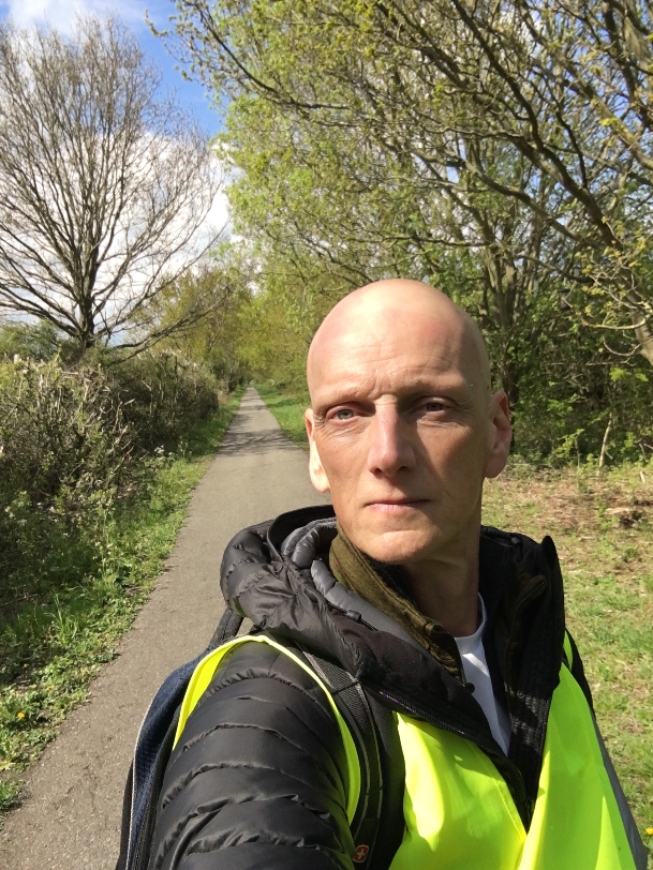
Nature makers: Derek Hilton-Brown
20-04-2026
Meet the nature makers
Case study
Guidance
©National Trust Images / Chris Lacey
20-04-2026
Meet the nature makers
Case study
Guidance
©National Trust Images / Chris Lacey
In conversation with
Ecologist at Walk Wheel Cycle Trust
Derek Hilton-Brown has spent three decades working in a variety of landscapes and has been an in-house ecologist at Walk Wheel Cycle Trust for almost five years. Few places have captured his attention quite like parts of the Cheshire and Deeside Greenway.
When he first walked the route during an ecological assessment, he saw what others may have missed: a long, linear opportunity to reconnect both people and wildlife with the wider countryside.
In his words, “Greenways like this are more than paths, they’re arteries of habitat which stitch together fragments of woodland, meadow, and wetland that would otherwise remain isolated.”
The Cheshire and Deeside Greenway has inspired many local partnerships between Walk Wheel Cycle Trust and organisations that share green values and interests.
“Ecology thrives when people feel ownership of their green spaces, and none of our work happens in isolation” Derek explains. “We work with many dedicated and enthusiastic people along the length of the Greenway and beyond.”
From loyal volunteers to local authority linkups across borders, Derek talks to us about how place-based partnerships are the backbone of this living corridor, where people and nature move side-by-side.
Before you set off, click the boxes below for helpful insights to keep you on track.
Walk Wheel Cycle Trust’s partnerships are like the Cheshire and Deeside Greenway itself – connecting people, nature and places together in a way that benefits everyone. Click to read Derek’s four key benefits of partnership working, then scroll down to discover what they look like on the Greenway.
The Cheshire and Deeside Greenway builds lasting bridges between nature and community.
Walk Wheel Cycle Trust has extensive experience engaging communities with natural spaces. Thanks to the funding and support of partners, including Chester West and Cheshire Council and the Networks for Nature group, they’ve been able to understand what changes people want along the Greenway. And then worked with them to make it happen.
Derek gives us a snapshot of how this gave people of all ages, backgrounds and abilities a voice in the future of the Greenway.
“When over half of the people we asked said they wanted to see more plants on the Greenway, we sprang into action. Our engagement officers reached out to existing community groups that support the Greenway and they raised funds to plant thousands of spring flower bulbs along the path.
As well as attracting people to use the path, it benefits nature at the same time.”
“Walk Wheel Cycle Trust wanted to encourage more children to use the Greenway. So we got our heads together with children at Newton Primary School and Arches Community Primary School, as well as their parents, guardians and carers.
During a series of engagement workshops, pupils designed colourful artworks, attracting more young people to explore the path, changing travel habits and encouraging cyclists to slow down in their shared space.”
“Almost a third of local residents we spoke to said they were concerned about how fast people were cycling on the Greenway. So our team installed two chicane gates outside Newton Primary School to help reduce speeds.
After two years we were happy to see that the number of people using the Greenway increased by 53% and cycling speeds reduced by 34%.”
“Walk Wheel Cycle Trust also worked with businesses on the Winsford Industrial Estate to encourage more people to use the Greenway to commute to work.
We discovered that employees either didn’t know about the network of paths or the destinations it linked to.
To get the word out, we held events and activities to encourage more active travel. As a result, the Greenway now provides a space for people to enjoy commuting under their own steam. And the Connah’s Quay section of the path now sees around 72,000 pedestrians and 147,000 cycle trips every year, according to a Route User Intercept Survey.”
“We’re enabling more people to get closer to our green spaces. Chester Zoo’s activities within the Networks for Nature project help us reach out to schools, families, young people and community groups that need a little extra support.
These activities include:
Whenever and wherever nature needs a helping hand, partnerships can reach further and wider to find the right people with the right tools.
Derek explains how working together has made nature bigger, bolder and more beautiful along the Greenway.
“By joining an earlier project led by Chester Zoo called Nature Recovery Corridor, the partnership of organisations involved was able to dedicate time and resources to help give disadvantaged groups better access to nature by restoring habitats over a 10-mile range from Chester to Ellesmere Port.
Local schools and community volunteers were involved in all sorts of nature-boosting activities that connect people and wildlife. These included:
“To make it easier for people to get on or off the Greenway, we were supported by the Networks for Nature partnership to improve the embankment access points.
Some were steep and many were overgrown. So we used our skills to remove vegetation, planted wildflowers and improved the seasonal ponds. As well as making the paths more accessible, it’s given nature space to grow and diversify.”
“Part of my role is to advise on habitat-enhancement works and increase habitat connectivity along the route. Over recent years this has included putting measures in place to protect rarer and more vulnerable species.
Walk Wheel Cycle Trust’s estates team has also been involved in creating wetlands, managing scrubs, maintaining mixed habitats and managing wildflower grasslands to improve species diversity.
We’ve also worked hard to protect bats within bridges, water voles and otters in our adjacent watercourses, badgers who make homes in the wooded railway embankments and great crested newts in our ponds and ditches.
It’s thanks to partnerships that we can continue to offer and apply expertise that helps these rare species recover.”
“When we develop greenways we embed nature recovery right from the start. This includes designing climate change mitigation into the construction stage, speaking to the local authority maintenance teams who will be caring for the Greenway on the ground and engaging with the local communities who will use it.
Working in partnership, we can be sure to maximise the potential of the Greenway to act as a crucial carbon sink, absorbing carbon dioxide from the atmosphere to mitigate the effects of climate change.”
The Greenway is part of a network of green spaces across towns and cities, so the ability to collaborate across local authority borders is essential.
Derek tells us how cross-border partnerships have benefited both the local authorities and the Greenway.
“Partnerships between local authorities can make it easier to deliver green projects and overcome complex challenges as you combine resources, skills and knowledge. Our relationships became stronger as a result of working more closely together, and we developed links with a wider range of environmental NGOs, local landowners, donors, charities and community groups.
And the wider your reach within the community, the more likely local stakeholders are to carry any green changes forward.”
“Walk Wheel Cycle Trust is on the steering group for Bionet Wales with 4 local authorities. This ensures that any activities on the Cheshire and Deeside Greenway funded by the Welsh Government both complement and enhance any Bionet Wales projects.
Alongside Networks for Nature, the picture emerges of a web of network of nature recovery projects that has the potential to be greater than the sum of its parts.”
“Our cross-border partnerships have enabled us to install three signs with distances and times on most common walking and cycle routes, helping people to plan their journeys. We’re also working together to install seating along the Greenway so even more people can take an extra moment to enjoy nature.”
Collaborating with different partners had immediate financial benefits for the Greenway. Demonstrating shared goals established greater credibility and opened the door to future funding opportunities.
Derek also includes two examples of when partnerships have accessed harder to reach funding as part of a wider nature recovery programme.
“Walk Wheel Cycle Trust worked with Cheshire West and Chester Council to secure Emergency Active Travel Fund funding released during the pandemic.
Our partnership helped secure the fund by being able to react quickly together with:
“Our partnership with the Networks for Nature project didn’t happen in isolation. It was kickstarted when Chester Zoo was awarded a National Lottery Heritage Fund grant of over £4 million, with significant match funding from Chester Zoo’s core funds, Westminster Foundation, Lord Leverhulme’s Charitable Trust and other donors.
Working in partnership and collaborating on funding bids have given us access to national funding for our localised greenway work that would otherwise be almost impossible to reach.”
“In partnership with Flintshire Council and Denbighshire Council, we received a share of the Welsh Government Core Grant funding to enhance biodiversity along the Greenway. It allowed us to expand our work even further, creating meadowland from scrubland, improving ponds and helping volunteers receive qualifications in handling tools such as loppers and cutters, hedging and orchard planting.”
Looking for more ideas on how your local authority can manage your greenways for people and nature? Read on for inspiring examples from around the UK.
Running along the old railway branch line from Berkswell to Kenilworth Junction, it forms part of the National Cycle Network and Warwickshire Country Park. The Greenway is well maintained for both people and nature and provides key walking, wheeling and cycling links that include the University of Warwick, Crackly Woods and the Tocil Wood and Nature Reserve.
Explore Kenilworth GreenwayOne of the best-loved and most used greenways in Northern Ireland, it starts in the heart of Belfast’s Titanic Quarter and meanders seven miles out into the County Down countryside. There’s an active travel hub to empower people to commute by bike and have a positive impact on the air quality. The Greenway is managed by park and recreation teams across different local authorities.
Explore Comber GreenwayThis off-road section of Route 7 is part of the National Cycle Network and 250,000 people choose to walk or wheel it every year. It’s a huge benefit for the community as it’s within a five-minute walk of three schools, a hospital, several supermarkets, the town centre and directly connects to Paisley Canal Railway Station. It was funded through the Scottish Greenways Programme.
Discover the Scottish Greenways ProgrammeExplore the Millennium Greenway for a day out
Chester Greenway blooms thanks to community project - Walk Wheel Cycle Trust
Chester schools create art trail to Greenway - Walk Wheel Cycle Trust
Millennium Greenway part of Chester Zoo’s £4m wildlife project - Walk Wheel Cycle Trust
Designing green and blue infrastructure for active travel networks