Community guide to co-design
18-03-2026
Get started with...
Guidance
©National Trust Images / Paul Harris
18-03-2026
Get started with...
Guidance
©National Trust Images / Paul Harris
Co-design is a way to bring different people with different viewpoints together, to come up with new ideas for their community that give local green spaces, places and people a helping hand.
Alex Quattrone, Research and Development Manager at Neighbourly Lab, defines co-design as follows:
“Co-design brings people who are affected by a problem together with organisations, experts and decision makers to come up with shared solutions.”
Whilst there are different ways to approach this process, the principles of co-design should feel the same. Alex summarises these as:
Crucially, co-design involves people with first-hand experience of a problem or an issue, making it as easy as possible for them to share their views and shape the outcome.
It moves groups along a journey from insights and questions to ideas, solutions and testing – sometimes at speed.
Read on to discover how to run a co-design process based on these principles, taking groups outside their comfort zone to unexpected places that give people and nature a helping hand.
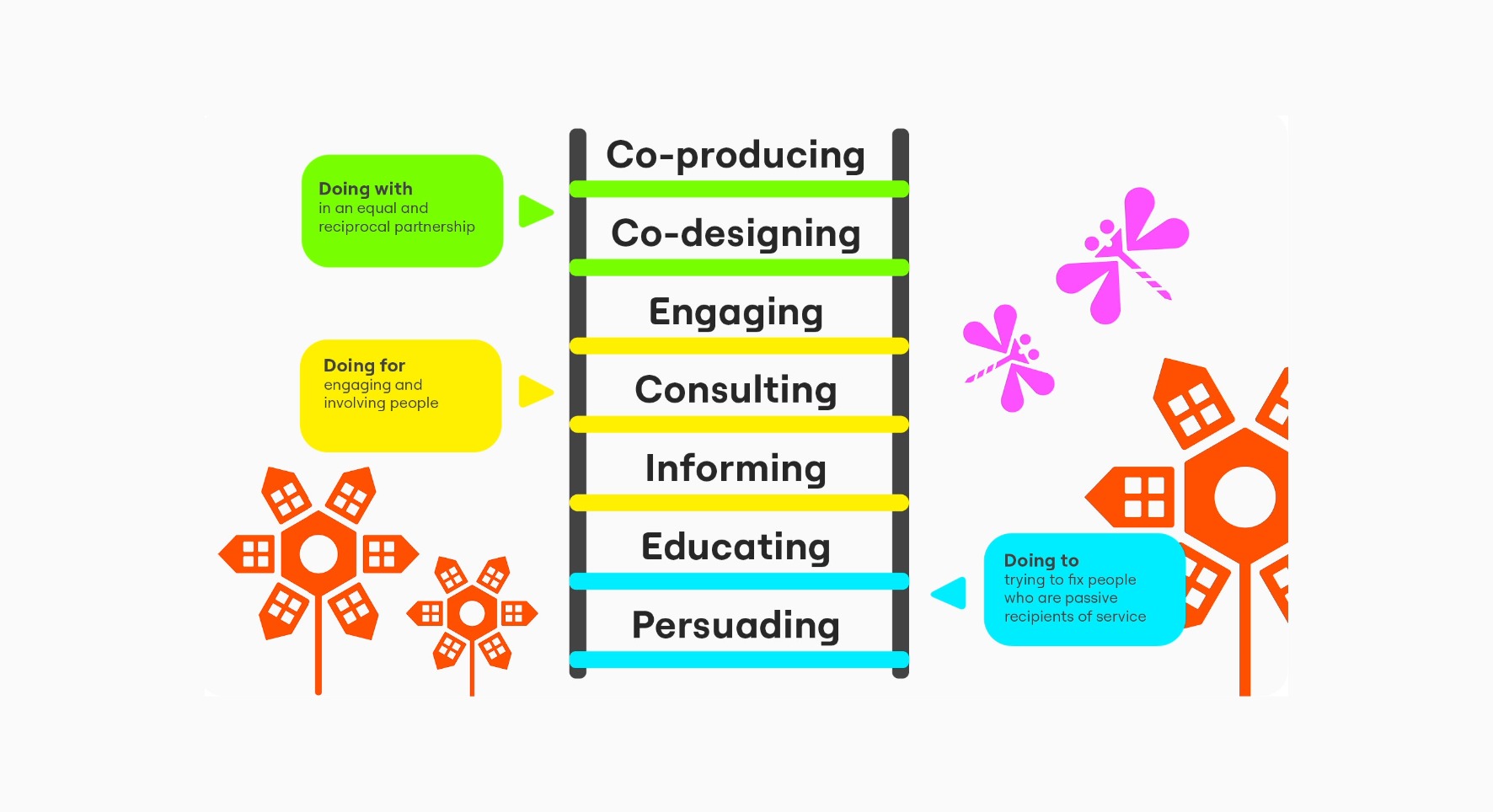
Alex explains how co-design is different to other forms of engagement, based on Arnstein's Ladder of Citizen Participation. Scroll through for more.
Co-design can look quite different to established ways of working. The Co-Production Collective shares how helps people and nature in urban communities.
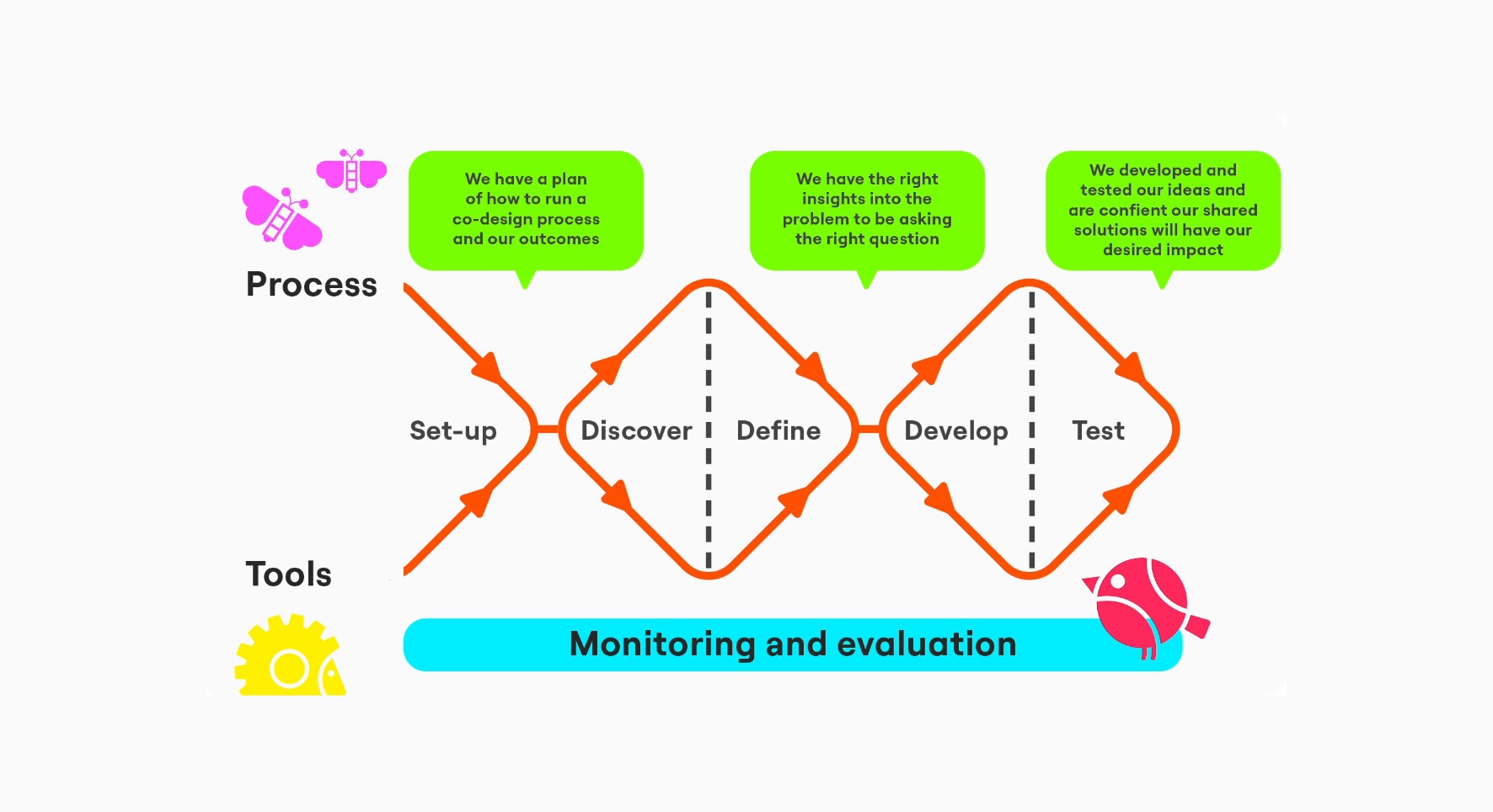
The Design Council’s Double Diamond model is a way to move people and organisations along the co-design process. Scroll down to discover more about each stage, then download our plan-making template to guide you through.
The aim here is to open the conversation, bringing the right people in to help you discover what’s important to those who call the place you’re working in home.
It’s about community-led research that will challenge assumptions and build relationships with participants.
Expand the arrows to discover how to unlock new views and experiences in a welcoming, inclusive way.
Click the buttons for more community research and planning tools.
What is it
Why you use it
Top tips
What is it
Why you use it
Top tips
What is it
Why you use it
Top tips
What is it
Why you use it
Top tips
What is it
Why you use it
Top tips
Finally, here are nine tips to take away for the Set-up and Discover phases:
The aim of this stage is to define the question or challenge you need to answer, using what you’ve learnt from your community during the Discovery phase.
It’s important to enter the Define phrase with a curious mindset. Trust your instincts, look for inspiration and keep the work energised and pacey.
Expand the arrows to learn how to make sense of what your Discovery insights might mean, and to start framing the key question that will define how your organisation can deliver real changes for nature and people.
The first step in the Define stage is to come together as an organisation to share insights from the Discover phase.
Seeing these together will help you to reflect on the neighbourhood’s relationship with nature, and how access to green spaces could help change things for the better.
Expand the next arrow to start framing your key questions for the Develop phase.
‘How might we…?’ is a way of asking a question that invites exploration and ideas.
It acknowledges that we don’t know the answer, and that there are different ways you might answer it.
The question contains: the challenge/opportunity, an action and a user.
The aim of this stage is for your organisation to generate lots of ideas to tackle the challenge identified in your chosen ‘How might we’ question.
Creative thinking is a team sport. You should involve other team members, stakeholders or service users to get a range of perspectives.
The ideas can be practical solutions or ‘wilder’ concepts that go beyond the status quo. This stage is intended to be a fast and iterative way to create new concepts and refine them based on feedback from people and stakeholders.
Expand the arrows for more about the Develop phase.
Before you start generating ideas, pause and take stock of where you are in the co-design process by answering these three questions:
This is a chance to remind everyone in the Develop team of the community insights that led you to your key question and – if needed – refine the wording to ensure it truly reflects the conversations from the co-design process.
It will help make sure everyone has the same understanding of the question and what it means for the place before moving on to creative ideas.
Next, think about how your sessions to create ideas will work with three more questions as follows:
It’s likely you’ll need to shortlist your ideas before moving on to testing. To do this, think about three questions:
Once you have a shortlist, you can start to understand more about each idea e.g. where it came from, what it entails in practice, how the user might benefit, what the impact might be and any wider context.
Download the ‘Ideas development template’ via the button for a framework to develop these points. Ideally, the person who suggested the idea would be part of this.
At the end of the process, your ideas should be scoped sufficiently to share back, test and refine them with people in a more meaningful way.
The aim of this stage is to release ideas off the page and out into the real world to get feedback and buy-in from your community and key stakeholders.
It is a critical part of the co-design process. It’s a chance to engage potential delivery partners and even funders at an early stage.
During testing, look closely at how people respond. As well as testing the viability of an idea, this can help you consider what elements people or groups might take more ownership of in delivery.
Leave time to reflect and refine based on peoples’ feedback, so your final draft is representative of what people think or feel.
Some ways to test your ideas could be:
The Double Diamond model supports inclusive design. Here are three other ways to ensure everyone can participate fully in the co-design process.
Here are some ways to help people settle in and get comfortable during co-design.
Blob Tree is a tool to check in on how a group is feeling about a subject or exercise. Encourage people to place the ‘blob’ figure that best represents their emotions onto a tree and take the conversation from there.
More about Blob Tree
59 second sketch gives everyone a prompt (e.g. what do you love most about nature in your neighbourhood?) and 59 seconds to draw their answer. Ask the group to share their drawings with the group.
Yes and / Yes but starts with a prompt (e.g. let’s offer an internship) and builds on the idea, with each person adding a point using ‘yes, and...’. to shape it into something bigger. Use ‘Yes, but’ to spot any potential challenges.
Five whys digs into the cause of an issue, uncovering glitches in delivery or processes along the way. Start with a description of the problem, then ask and answer ‘why’ five times to reach a statement about what went wrong.
Theory of five whysNature Neighbourhoods was a national partnership programme between the National Trust, RSPB and WWF, funded by the National Lottery Community Fund and the Co-op.
The programme’s big idea was to work alongside 18 community organisations over 2 years, helping them co-create people-powered plans for nature in their own neighbourhoods.
Each collaborative plan was firmly rooted in whatever nature and climate actions are most important to the people living and working there. And they were brought to life with Nature Neighbourhood’s funding, support and training.